
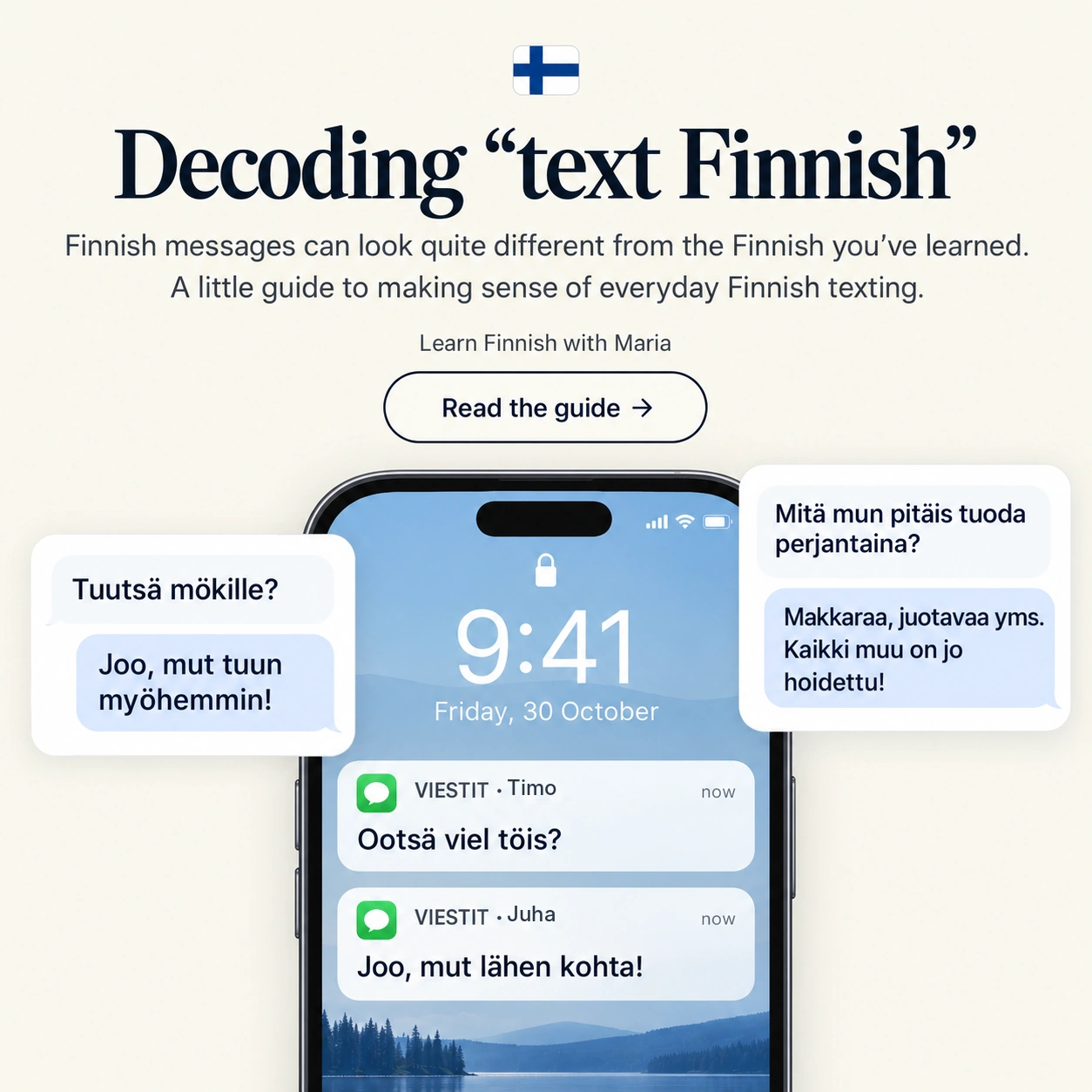
Are you part of a sähly or jalkapallo WhatsApp group and sometimes struggle to understand the messages?
Or perhaps you’re arranging a mökki weekend with Finnish friends and find yourself trying to decode what everyone is writing?
Finnish text messages can look quite different from the Finnish you’ve learned.
Here’s a little guide to help you recognise some of the most common shortened forms and make sense of everyday Finnish messages.
* Note about the English translations: If the English looks a little broken, it’s intentional! The word-for-word translations preserve Finnish word order and structure to help you recognise vocabulary and language patterns.
Are Finnish text messages just wacky?
You know what this means:
Oletko sinä vielä töissä?
[Are-question you still at work?]Then someone sends you this:
Ootsä viel töis?
Same language. Same question. Rather different appearance.
But there are patterns behind the missing letters.
Is this “text” Finnish or spoken Finnish?
Often, both! Much of casual texting is simply puhekieli (everyday spoken Finnish) written down, sometimes with additional abbreviations.
Some Finns prefer kirjakieli (standard Finnish), while others write the way they speak. Even texting your boss in puhekieli can be perfectly acceptable, depending on your relationship and workplace.
Recognising these forms helps you connect the Finnish you’ve learned with the Finnish people actually use.
Give it a go, it’s fun! I promise.
Is there an official way to write these messages?
Well, no, not really.
People may write only kirjakieli and some write the way they speak, shorten further or mix different forms. Se riippuu monesta asiasta 😊 For example: region, age and and who they are writing to and so on.
Do I need to write like this?
You can do, but you don’t have to. It is a choice. This guide is intended to help you decode them.
And actually, some of these forms hurt my brain a little also. I would quite happily leave a few more letters in.
Regarding slang words, there is a small slang section at the end. Younger people may use plenty more, some of which I probably would need to look up anyway.
This is quite important to know and learners do not often use this more natural sounding expression.
How do Finns say “send a message”?
We usually say:
laittaa viesti
[to put message]For example:
Laita viesti, jos oot myöhässä.
[Put message if you are late.]
But if you want to use the verb send, you can say:
lähettää viesti
[to send message]
It just sounds a bit more formal, and maybe a bit awkward if the situation is rather casual but it is correct Finnish, it is not wrong.
1. Common shortened personal pronouns in texting
| Casual Finnish | Standard Finnish and literal English |
| mä | minä [I] |
| sä | sinä [you] |
| se | hän / se [he / she / it] |
| ne | he / ne [they / those] |
In casual Finnish, se is commonly used about living things, both humans and animals, and ne about people.
This is normal spoken Finnish and does not mean that the speaker considers everyone an object.
The forms me and te usually remain unchanged.
2. Common shortened possessive pronouns
| Casual Finnish | Standard Finnish and literal English |
| mun | minun [my / of me] |
| sun | sinun [your / of you] |
| sen | hänen / sen [his, her / its, of it] |
| meiän | meidän [our / of us] |
| teiän | teidän [your / of you, plural] |
| niitten | heidän / niiden [their / of them] |
You may also see niiden, which is already the standard form when referring to things.
🇫🇮 Finnish Fluency Lab
I’ve done the awkward bit for you!
No hunting for speaking partners. No wondering what to say. Just come along and practise Finnish with us.
3. Other common pronoun forms
Finnish pronouns appear with different endings. In messages, both the pronoun and the ending may be shortened.
| Casual Finnish | Standard Finnish and literal English |
| mulla / mul | minulla [at me] |
| sulla / sul | sinulla [at you] |
| meillä / meil | meillä [at us] |
| teillä / teil | teillä [at you, plural] |
| musta* / must | minusta [from me] |
| susta / sust | sinusta [from you] |
| mun mielestä | minun mielestäni [from my opinion] |
| sun mielestä | sinun mielestäsi [from your opinion] |
* yes, this is also the colour black = musta. Well spotted! This is how we speak 🙂
4. Common shortened versions of: This, that, these and those
| Casual Finnish | Standard Finnish and literal English |
| tää | tämä [this] |
| toi | tuo [that] |
| se | se [it / that] |
| nää | nämä [these] |
| noi | nuo [those] |
| ne | ne [they / those] |
| tän | tämän [of this] |
| ton | tuon [of that] |
| tota | tuota [that, partitive] |
| tohon | tuohon [into that / onto that] |
| täl | tällä [on this / with this] |
| tol | tuolla [on that / with that] |
| siin | siinä [in it / in that] |
| nois | noissa [in those] |
Tota can also be a hesitation word, similar to “well” or “um”. Context tells you whether it refers to something or simply gives the speaker or writer time to think.
5. Here and there
| Text or casual Finnish | Standard Finnish and literal English |
| tääl | täällä [here] |
| täält | täältä [from here] |
| tuol | tuolla [there] |
| tuolt | tuolta [from there] |
| tonne | tuonne [to there] |
| siel | siellä [there] |
| sielt | sieltä [from there] |
| siin | siinä [in it / there] |
6. Small words that appear everywhere
| Casual Finnish | Standard Finnish and literal English |
| mut | mutta [but] |
| et | että [that] |
| sit | Sitten [then] |
| nii | Niin [so / like that] |
| kyl | Kyllä [yes / indeed] |
| vaik | Vaikka [although / even if] |
| ku | kun / kuin [when, because / than, like] |
| viel | Vielä [still / yet] |
| kans | kanssa / myös [with / also] |
As shown, some short forms can have more than one meaning.
Et may be a shortened form of että:
Mä luulen, et se tulee.
[I think that he/she comes.]
In standard Finnish for reference:
Minä luulen, että hän tulee.
[I think that he/she comes.]
Or, et can also be the negative verb used with sinä:
Et sä tuu?
[Do-not-question you come?]
In standard Finnish for reference:
Etkö sinä tule?
[Do-not-question you come?]
Similarly, the word ku may represent either kun or kuin:
Laita viestiä ku tuut.
[Put message when you come.]
In standard Finnish:
Laita viestiä, kun tulet.
[Put message when you come.]
Se on isompi ku tää.
[It is bigger than this.]
In standard Finnish:
Se on isompi kuin tämä.
[It is bigger than this.]
7. The final -n disappears
| Casual Finnish | Standard Finnish and literal English |
| seki | Sekin [that also] |
| kuitenki | Kuitenkin [however / anyway] |
| jotenki | Jotenkin [somehow] |
| tietenki | Tietenkin [of course] |
| kuitenkaa | Kuitenkaan [however / nevertheless] |
| sillo | Silloin [then / at that time] |
| eteenpäi | Eteenpäin [forwards] |
| aikasemmi | Aikaisemmin [earlier] |
| nopeemmi | Nopeammin [more quickly] |
Not every writer removes the -n. The same person may write kuitenkin in one message and kuitenki in the next.
8. Past participles may lose their final -t
Forms ending in -nut, -nyt, -lut or -lyt sometimes lose the final -t.
| Casual Finnish | Standard Finnish and literal English |
| ollu | Ollut [been] |
| tehny | Tehnyt [done] |
| menny | Mennyt [gone] |
| saanu | Saanut [got / received] |
| pärjänny | Pärjännyt [managed / succeeded] |
| aiheutunu | Aiheutunut [been caused] |
| ehtiny | Ehtinyt [had time] |
9. Conditional forms may lose the -i
Conditional verb forms contain -isi- in standard Finnish. In casual Finnish, this commonly becomes -is-.
| Casual Finnish | Standard Finnish and literal English |
| olis / ois | Olisi [would be] |
| olisin / oisin | Olisin [I would be] |
| vois | Voisi [could / would be able] |
| pitäis | Pitäisi [should] |
| sais | Saisi [would get / could get] |
| tulis | Tulisi [would come] |
| menis | Menisi [would go] |
| pelottais | Pelottaisi [would frighten] |
| loukkaantuis | Loukkaantuisi [would become injured] |
This pattern also appears in questions:
Pitäiskö lähtee?
[Should-question leave?]
In standard Finnish:
Pitäisikö lähteä?
[Should-question leave?]
10. Common sound and spelling changes
Some words do not simply lose one ending. Their internal letters may change too.
| Casual Finnish | Standard Finnish and literal English |
| tiiä | Tiedä [know] |
| en tiiä | en tiedä [I do not know] |
| tehä | Tehdä [to do] |
| nähä | Nähdä [to see] |
| tehään | Tehdään [is done / we do] |
| nähään | Nähdään [is seen / we see] |
| kattoo | katsoa / katsoo [to look, to watch / looks, watches] |
| katotaan | Katsotaan [is looked / we look] |
| ite | Itse [self] |
| semmonen | Sellainen [that kind of] |
| tollanen | Tuollainen [that kind of] |
| oikeestaan | Oikeastaan [actually] |
| jotku | Jotkut [some] |
| johonki / johki | Johonkin [into somewhere] |
| vuoks | Vuoksi [because of] |
Worth to point out!
“Katotaan” often functions as a complete reply.
Literally, the structure is “is looked” or “we look”, but it is commonly used when a decision has not yet been made.
Also, worth to point out!
“Katotaan”, is often also preceded with “No niin, no, katotaan.”
If the person just wants to move onto the next topic and not continue to make specific plans at that moment in time.
They are not dismissing you or the plans entirely, they just want to move on and decide later.
11. Questions in messages
The standard question ending -ko / -kö is sometimes written as -ks. The pronoun sä may also become attached to the verb.
| Casual Finnish | Standard Finnish and literal English |
| onks | Onko [is-question] |
| eiks | Eikö [is-not-question] |
| ootsä / ooks | oletko sinä [are-question you] |
| tuutsä / tuuks | tuletko sinä [come-question you] |
| haluutsä / haluuks | haluatko sinä [want-question you] |
| mennääks | menemmekö [go-question we] |
| Käydääks | käymmekö [visit-question we] |
| pitäiskö | pitäisikö [should-question] |
You may see both ootko and ootsä. Both come from the same standard structure.
12. Common shortened question words include:
| Casual Finnish | Standard Finnish and literal English |
| mis | missä [in where] |
| mist | mistä [from where] |
| miks | miksi [why] |
| millo / millon | milloin [when] |
Words such as mitä, mikä and kenen often remain unchanged.
13. The verb olla
| Casual Finnish | Standard Finnish and literal English |
| mä oon | minä olen [I am] |
| sä oot | sinä olet [you are] |
| se on | hän on / se on [he/she is / it is] |
| me ollaan | me olemme [we are] |
| te ootte | te olette [you are, plural] |
| ne on | he ovat / ne ovat [they are] |
| mä en oo | minä en ole [I am not] |
| se ei oo | hän ei ole / se ei ole [he/she is not / it is not] |
| me ei olla | me emme ole [we are not] |
| ne ei oo | he eivät ole / ne eivät ole [they are not] |
Notice me ollaan. Casual Finnish commonly uses the passive-looking verb form with me, we do not say “me olemme.” Like never ever!
14. Other everyday verbs
| Casual Finnish | Standard Finnish and literal English |
| tuun / tuut | tulen / tulet [I come / you come] |
| meen / meet | menen / menet [I go / you go] |
| haluun / haluut | haluan / haluat [I want / you want] |
| tiiän | tiedän [I know] |
| lähen | lähden [I leave] |
15. Common abbreviations
Abbreviations are different from spoken Finnish. They replace a word or expression with only a few letters.
| Abbreviation | Full Finnish and literal English |
| vkl | viikonloppu [week-end] |
| vk | viikko [week] |
| pv | päivä [day] |
| vrk | vuorokausi [24-hour period] |
| klo | kello [clock / at] |
| hlö | henkilö [person] |
| henk. koht. / henk koht | henkilökohtaisesti [personally] |
| esim. | esimerkiksi [for example] |
| jne. | ja niin edelleen [and so forwards] |
| yms. | ynnä muuta sellaista [and other such] |
| tms. | tai muuta sellaista [or other such] |
| n. | noin [approximately] |
| min | minuutti / minuuttia [minute / minutes] |
16. Slang found in everyday messages
Slang changes the vocabulary itself. You cannot always reconstruct the standard word by adding a missing letter.
| Slang | Standard Finnish and literal English |
| kämppä | asunto / koti [flat / home] |
| remppa | remontti [renovation] |
| duuni | työ [work] |
| safka | ruoka [food] |
| hima | koti [home] |
| mesta | paikka [place] |
| frendi / kamu | kaveri [friend] |
| kalja | olut [beer] |
| äijä | mies / tyyppi [man / person] |
| dokaaminen | alkoholin juominen [drinking of alcohol] |
Some of these words are more strongly marked as slang than others. Kämppä, remppa and duuni are widely recognised.
Words such as hima, safka and dokaaminen depend more on the region speaker, age group and situation.
Regarding the region specifically, Helsinki area for example, has a lot of their own slang words that you may not hear elsewhere. The rest of Finland is more civilised and we communicate properly.
A couple of final examples
Ootsä viel töis? Mä laitan viestii ku lähen.
[Are-question you still at work? I put message when I leave.]
In standard Finnish:
Oletko sinä vielä töissä? Minä laitan viestiä, kun lähden.
[Are-question you still at work? I put message when I leave.]
Onks se ollu tääl? Mä en oo nähny sitä.
[Has-question he/she been here? I have not seen him/her.]
In standard Finnish:
Onko hän ollut täällä? Minä en ole nähnyt häntä.
[Has-question he/she been here? I have not seen him/her.]
And that’s all for today. I hope this is helpful. Not meant as a full guide nor encyclopedia of Finnish texting abbreviations but it includes a wide range of the most common ones to get you started.
If you have other burning questions or topics about Finnish. Feel free to drop me a line and I can do my best to encode it for you.
🇫🇮 Maria, Your Finnish Language Instructor
Leave a Reply