This does not come as a big surprise I guess, but let’s have a look at some examples 🙂
One of the reasons Finnish feels confusing at the beginning is simple:
It does not map neatly into English.
This is an important point to accept early on.
Adult brains want to ask why, why, why. They try to take everything new and fit it into something that already exists. That works in many areas of life, but with language learning it can slow you down.
Often the answer to the why is very simple:
Finnish is not a variation of English. It is a different language and a different system.
If you try to force Finnish into English structures, it will feel inconsistent and frustrating. It is like trying to fit a square peg into a round hole. It will never sit properly.
The shift happens when you allow the language to be what it is. Instead of forcing meaning, you start observing patterns.
Let’s look at this in practice.
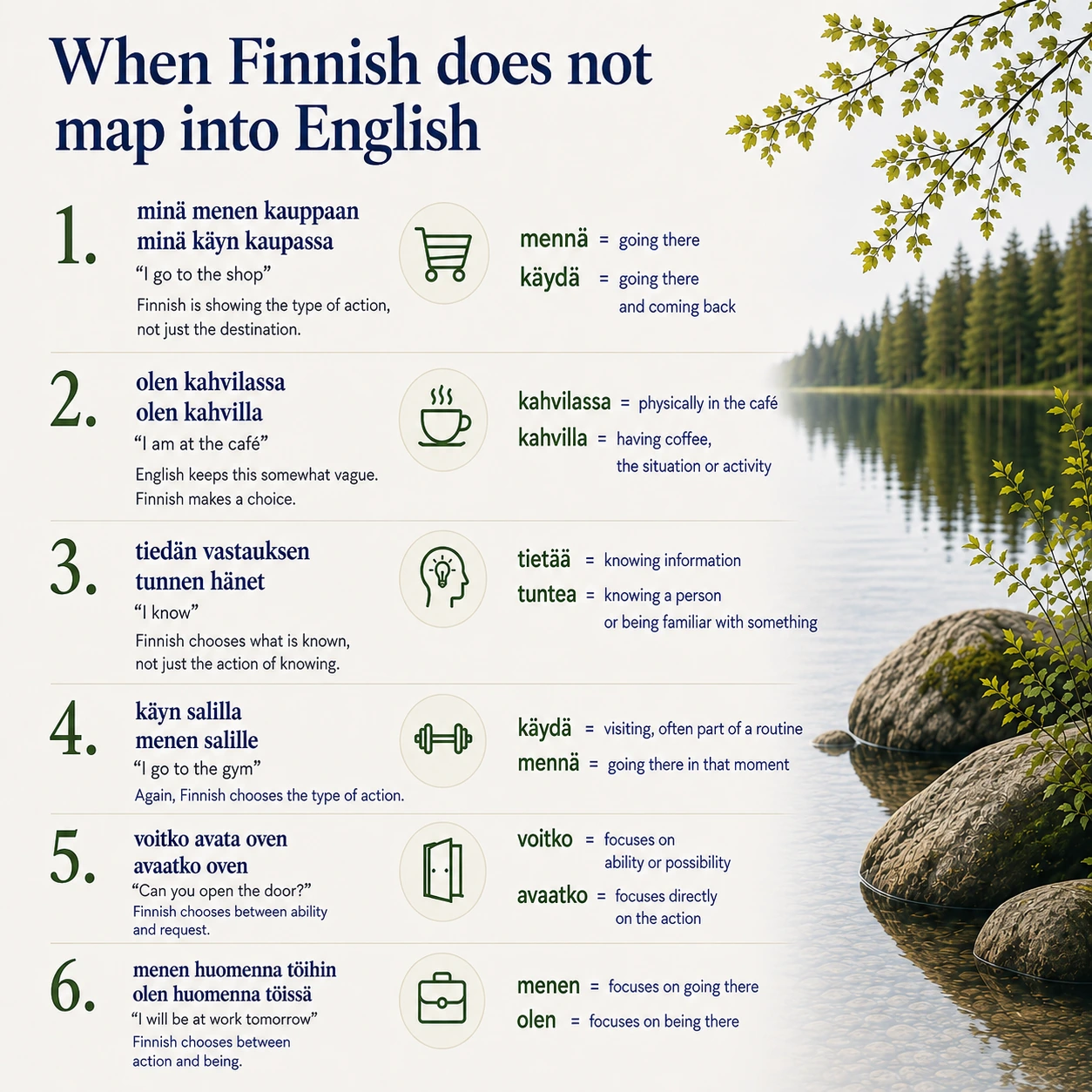
1. Movement vs visiting
minä menen kauppaan
minä käyn kaupassa
Both are often translated as “I go to the shop”.
But the meaning is different.
mennä = going there
käydä = going there and coming back
Finnish is showing the type of action, not just the destination.
2. Place vs situation
olen kahvilassa
olen kahvilla
Both can be translated as “I am at the café”.
kahvilassa = physically in the café
kahvilla = having coffee, the situation or activity
English keeps this somewhat vague. Finnish makes a choice.
3. Knowing a fact vs knowing a person
tiedän vastauksen
tunnen hänet
Both can be translated as “I know”.
tietää = knowing information
tuntea = knowing a person or being familiar with something
Finnish chooses what is known, not just the action of knowing.
4. Routine vs one-time action
käyn salilla
menen salille
Both can become “I go to the gym”.
käydä = visiting, often part of a routine
mennä = going there in that moment
Again, Finnish chooses the type of action.
5. Ability vs action
voitko avata oven
avaatko oven
Both are often translated as “Can you open the door?”
voitko = focuses on ability or possibility
avaatko = focuses directly on the action
Finnish chooses between ability and request.
6. Going vs being
menen huomenna töihin
olen huomenna töissä
Both can be translated as “I will be at work tomorrow”.
menen = focuses on going there
olen = focuses on being there
Finnish chooses between action and being.
The key idea
Finnish is not random. It is precise.
Where English often uses a more general expression,
Finnish often asks:
What exactly is happening here?
Is it movement, a visit, a state, a situation, a relationship, a fact?
What is / should be / could be known from the previous situation?
When you stop trying to translate everything directly and start noticing these distinctions, the language begins to organise itself.
Learn Finnish through real situations, not random grammar
This is the kind of pattern we practise in my Finnish classes.
We do not study grammar as a long list of rules to memorise. We start with real-life situations, such as going to work, coming home, visiting the shop, speaking with a colleague or managing everyday life in Finland. Then we slow down, notice the pattern, and practise it in small, useful chunks.
That is how Finnish starts to become more natural. You learn what to say, when to say it, and why the sentence works.
My teaching focuses on:
real-life Finnish you can actually use
speaking practice from the beginning
bite-sized grammar inside practical situations
pattern recognition so Finnish feels less random
ready-made sentence models that help you speak with more confidence
The goal is not to understand one grammar table perfectly. The goal is to build the kind of Finnish you can use in everyday conversations, step by step.
The latest course intake is now open for small-group Finnish courses.
Come and learn Finnish in a clear, practical and human way.



Leave a Reply