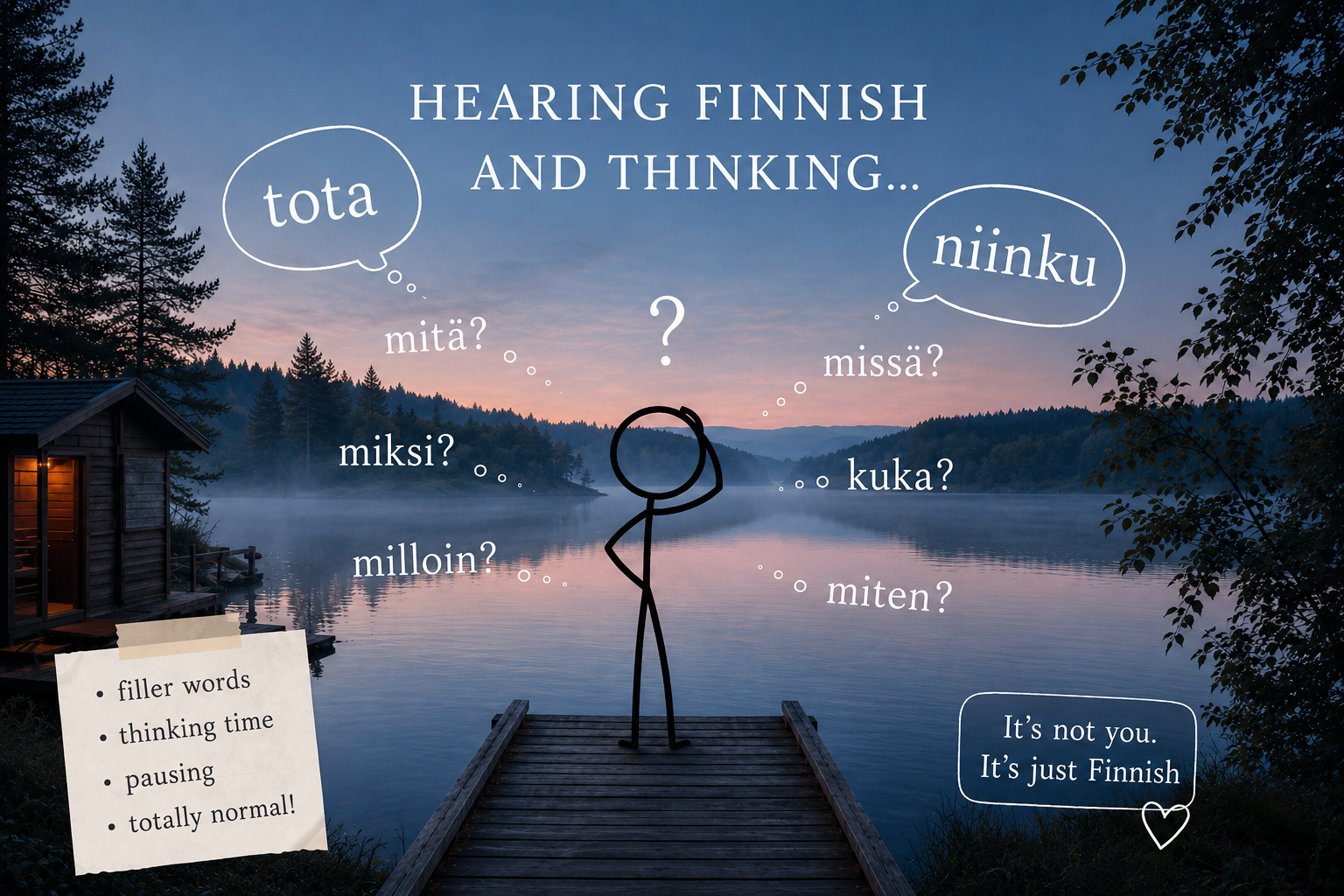
If you spend time listening to Finnish people speaking naturally, especially in conversations, cafés, workplaces, or everyday situations, you will start hearing two words constantly:
tota
and
niinku
And after a while you may start wondering:
“Why does everybody keep saying these words all the time?” 🙂
The good news is:
Usually they do not carry a huge meaning.
Very often, they are simply helping the speaker think.
And honestly, English does this too.
People say:
“like…”
“umm…”
“you know…”
“so…”
Finnish just has its own versions.
Let’s look at them a little more closely.
1. “Tota”
You will hear this everywhere in spoken Finnish.
tota…
joo tota…
mä tota mietin että…
It is often used when somebody is:
- thinking
- organising their thoughts
- hesitating slightly
- continuing a sentence
- buying time while speaking
For example:
joo tota mä en ehkä ehdi huomenna
“yeah, umm, I maybe won’t have time tomorrow”
Or:
mä tota halusin kysyä yhtä asiaa
“I, umm, wanted to ask one thing”
The important thing is:
Finnish people usually do not even notice they are saying it.
It is completely natural.
And actually, hearing these little filler words is often a sign that somebody is speaking naturally rather than reading perfect textbook Finnish.
2. “Niinku”
This one is extremely common.
Probably even more common than learners expect 🙂
Literally, niinkuin comes from:
niin kuin
“like / as / the way that”
But in spoken Finnish it often becomes:
niinku
And very often it works similarly to English “like”.
For example:
se oli niinku aika vaikee tilanne
“it was like quite a difficult situation”
Or:
mä olin niinku ihan väsynyt
“I was like really tired”
Sometimes it softens what is being said.
Sometimes it helps the speaker search for words.
Sometimes it just appears because the person is thinking while talking.
And sometimes…
Finnish people honestly use it a lot without even realising it 😄
Why this matters for learners
This is actually an important moment in Finnish learning.
Because many learners reach a point where they understand textbook Finnish reasonably well…
…but then real spoken Finnish suddenly sounds much messier.
People pause.
They restart sentences.
They use filler words.
They leave thoughts unfinished.
That is normal spoken language.
Real communication is not perfectly polished.
And once you start recognising words like tota and niinku, conversations often begin to feel much more understandable and human.
You stop trying to translate every single word literally and instead start recognising the rhythm of how Finnish people actually speak.
One important thing 🙂
You do not need to force yourself to use these words immediately.
Understanding them is already very useful.
And over time, if you spend enough time listening to natural Finnish, some of these patterns usually start appearing naturally in your own speech too.
That is often a sign that the language is beginning to feel more comfortable and automatic.
And honestly…
once you notice “tota” and “niinku”, you will probably start hearing them everywhere 😄
For more information about my teaching approach and how I can support learners in their journey, please check here: learnfinnishwithmaria.com
Thank you for reading and I wish you a good day.
Learn Finnish through real situations, not random grammar
This is the kind of pattern we practise in my Finnish classes.
We do not study grammar as a long list of rules to memorise. We start with real-life situations, such as going to work, coming home, visiting the shop, speaking with a colleague or managing everyday life in Finland. Then we slow down, notice the pattern, and practise it in small, useful chunks.
That is how Finnish starts to become more natural. You learn what to say, when to say it, and why the sentence works.
My teaching focuses on:
real-life Finnish you can actually use
speaking practice from the beginning
bite-sized grammar inside practical situations
pattern recognition so Finnish feels less random
ready-made sentence models that help you speak with more confidence
The goal is not to understand one grammar table perfectly. The goal is to build the kind of Finnish you can use in everyday conversations, step by step.
The latest course intake is now open for small-group Finnish courses.
Come and learn Finnish in a clear, practical and human way.


Leave a Reply