
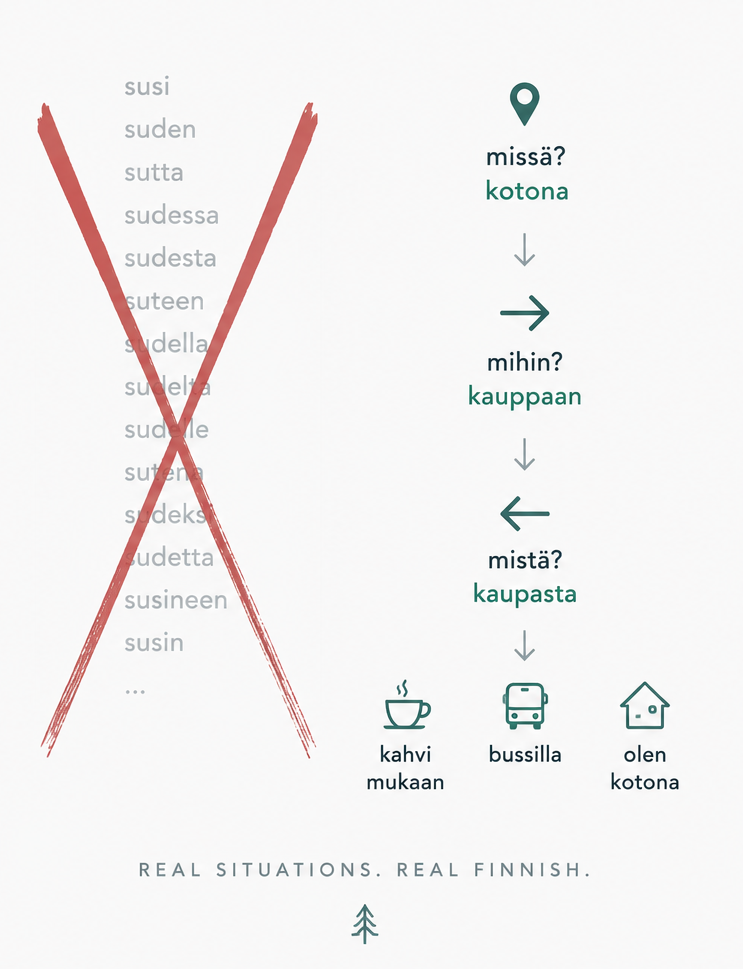
…but somehow end up being taught this instead:
🐺 SUSI = “wolf”
| Case | Finnish | English |
|---|
| Nominative | susi | wolf |
| Genitive | suden | of the wolf |
| Partitive | sutta | (some) wolf |
| Inessive | sudessa | in the wolf |
| Elative | sudesta | out of the wolf |
| Illative | suteen | into the wolf |
| Adessive | sudella | on the wolf |
| Ablative | sudelta | from the wolf |
| Allative | sudelle | onto/to the wolf |
| Essive | sutena | as a wolf |
| Translative | sudeksi | into a wolf |
| Abessive | sudetta | without a wolf |
| Comitative | susineen | with wolves |
| Instructive | susin | by means of wolves |
| Plural nominative | sudet | wolves |
| Plural partitive | susia | wolves (partial) |
Meanwhile the learner just wanted to know how to buy coffee ☕ and survive Prisma. 🔺♻️
BUT
Now their head is screaming:
“Excellent. My Finnish journey is over before it even began.”
What needs to be said is that the Finnish noun cases are actually very systematic.
The nonsensical part (in my view) is presenting them all at once completely divorced from reality.
Because yes… technically these forms exist.
But will you ever need them?
Well.
Let’s investigate.
One of my personal favourites is (drum roll..!!!):
🐺 SUDESSA
“in the wolf”
Yes.
“In the wolf.”
I am not sure it is a completely essential thing to urgently communicate in everyday life… (…or is it?)
Naturally, this raises some questions. (if not many).
🌲 Possible Real-Life Situations Where You Might Need “In The Wolf”
1. A very unfortunate biology documentary
“Mikromuovia löydettiin sudessa.”
“Microplastics were found in the wolf.”
2. A medieval fantasy situation that has escalated badly
“Velho piilotti timantin sudessa.”
“The wizard hid the diamond inside the wolf.”
3. A camping trip in Finland that has gone catastrophically wrong
“Puhelin on sudessa.”
“The phone is in the wolf.”
At this point the Finnish cases are not the problem anymore.
The real problem is what happened in this forest???
🌲 Then We Have KUUSI
KUUSI = “fir tree”
And yes, of course, we can also put this through all possible noun cases, why not right?
Because apparently that is a done thing. I will use one example here:
🌲 KUUSENA
“as a fir tree”
Again: A very normal thing to need immediately at A1/A2 level, I presume?
🎄 Real Situations* Where “As A Fir Tree” Might Actually Be Useful
*disclaimer: might not be real, I am unable to find or provide any actual evidence.
1. A Finnish Halloween party
“Hän tuli juhliin kuusena.”
“He came to the party dressed as a fir tree.”
2. Experimental theatre in Helsinki
“Näyttelijä esiintyy kuusena.”
“The actor performs as a fir tree.”
3. A low-budget Christmas play
“Sinä olet kuusena tänä vuonna.”
“You are the fir tree this year.”
🇫🇮 The Funny Thing Is…
Finnish itself is actually extremely logical.
The noun case system is not random at all.
The problem is not the endings.
The problem is presenting all possible endings for every noun immediately, completely separated from real life, meaning, or communication. I see this kind of example circulating online quite often. The posts take a random noun and then show all the ways it changes with the cases.
I am not 100% sure if these have been made to purposefully scare learners or if it is for informational or educational purposes. Maybe I will never know…
Anyway, let’s move on. Part of the logic of Finnish is that it tries to communicate the underlying ideas, such as:
- 📍 location
- ➡️ movement
- ⬅️ movement away
- 🔄 change
- 🎭 role/state
…and once this logic starts to become clear, you may suddenly realise that Finnish operates through patterns, becomes manageable and can be learnt.
Not in one block, but systemically and possibly without ever needing long lists or long explanations. When learning is tied to real-life situations, these, perhaps old-fashioned methods (sorry, don’t mean to offend anyone) become irrelevant (to an extent).
☕ What Learners Do Not Urgently Need:
- “inside the wolf”
- “functioning as a fir tree”
- “transforming into a wolf”
- “without a fir tree”
What they do need is:
missä?
where?olen kotona
I’m at home
mihin menet?
to where?
menen kauppaan
I’m going to the shop
Mitä otat?
What are you having?
kahvi mukaan
coffee to go
Miten menet sinne?
How will you go there?
bussilla
by bus
Real situations.
Real patterns.
Real Finnish.
🇫🇮 Finnish Isn’t Random
The endings may look complicated.
But the underlying logic (often) isn’t.
And once Finnish is taught through meaning and patterns instead of giant terrifying grammar tables…
…it suddenly starts making a lot more sense.
Thanks for reading 😄 Written for fun but also with a real message behind it. Just because it IS possible in Finnish to apply all the cases to every single noun, does not mean it is helpful nor of much educational value.
As a final note, I could pick on an endless list of these but it is your turn. If you’ve seen any other wonderful Finnish examples like “inside the wolf” or “functioning as a fir tree,” feel free to share them in the comments.
And if you’d like to learn Finnish through real-life situations, real conversations, and real patterns — instead of giant grammar tables — then feel free to get in touch or explore the current online courses 🇫🇮🌲

Leave a Reply