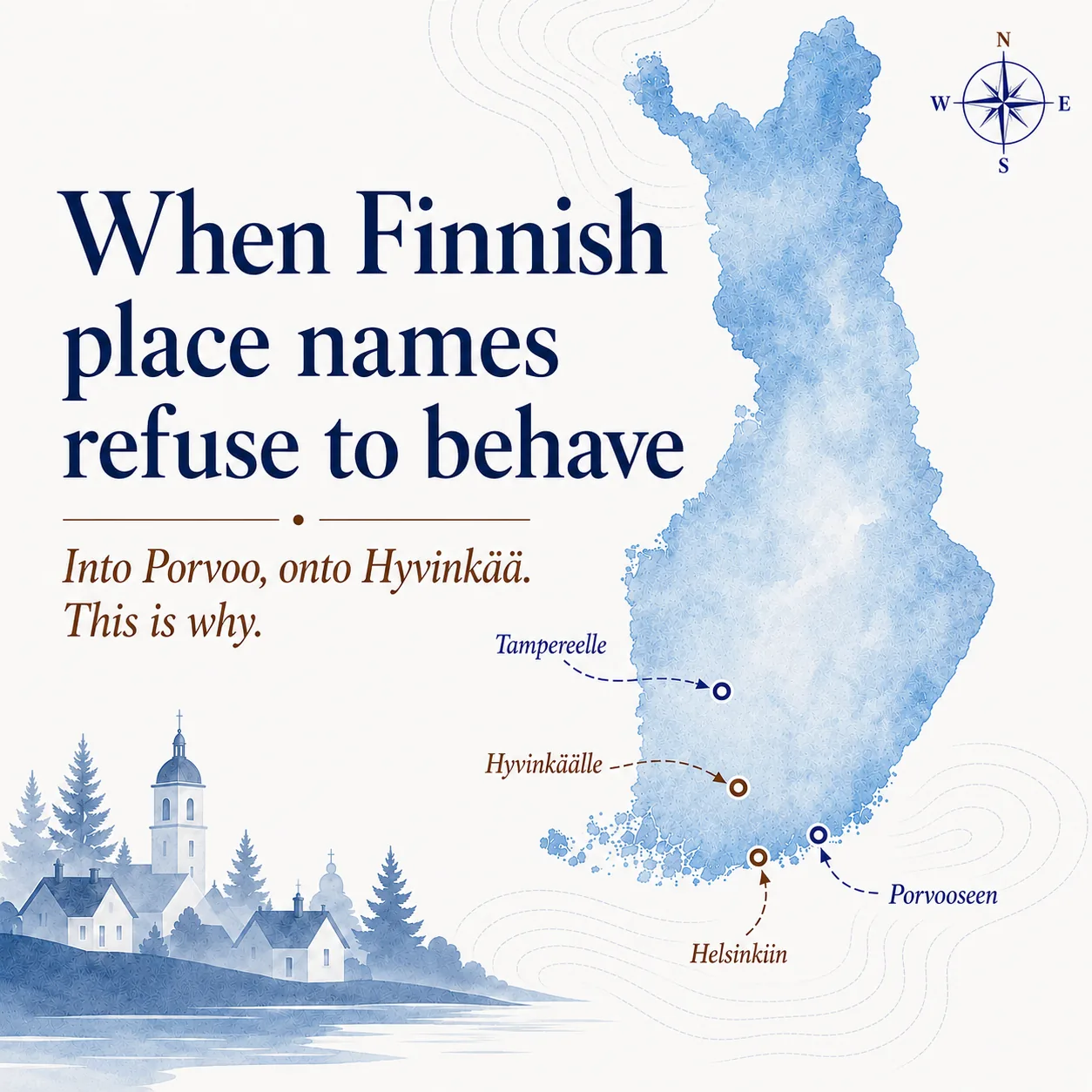
🇫🇮 Why do I go to Porvoo, but onto Hyvinkää?
Finnish place names can be confusing. Fact ✔️
Students ask about this all the time. Also fact ✔️
Writing an article about it, so that it can be sent during or after class to keep things nice and tidy. Final fact ✔️
So let’s talk about Finnish place names, because they are fun.
And by fun, I mean:
they look normal for about three seconds, and then suddenly everyone is arguing about endings.
For example:
Menen Porvooseen.
I am going to Porvoo.
But:
Menen Hyvinkäälle.
I am going to Hyvinkää.
And then your brain quite reasonably asks:
Why?
Why not:
Menen Porvoohon?
Or:
Menen Hyvinkäähän?
The short answer is:
Finnish place names have their own little personalities.
Some names use inner place endings, as if you are going into the place:
Porvoossa / Porvooseen
Helsingissä / Helsinkiin
Espoossa / Espooseen
Other names use outer place endings, as if you are going onto the place:
Hyvinkäällä / Hyvinkäälle
Tampereella / Tampereelle
Vantaalla / Vantaalle
There is logic behind this, but there is also history, geography, older meanings, dialect and local usage mixed together.
So yes, there are patterns that you can follow. Before we talk about why Porvoo and Hyvinkää behave differently, we need one small piece of grammar*.
* I literally detest that word but I guess it is part of language learning, to a point. But please speak first, practice. Grammar can come later.
In Finnish, place names usually change form depending on whether you are:
in a place
going to a place
coming from a place
There are two common sets of place endings.
One set feels more like inside / into / out of:
-ssa / -seen / -sta
For example:
Helsingissä — in Helsinki
Helsinkiin — to Helsinki
Helsingistä — from Helsinki
Another set feels more like on / onto / from:
-lla / -lle / -lta
For example:
Tampereella — in Tampere
Tampereelle — to Tampere
Tampereelta — from Tampere
So when a learner asks:
Why is it Porvooseen, but Hyvinkäälle?
They are really asking:
Why does one place name use the -ssa / -seen / -sta family, while another uses the -lla / -lle / -lta family?
And that is exactly the little Finnish place-name adventure we are about to enter.
So one town may be:
Turussa / Turkuun
while another very normal Finnish city is:
Tampereella / Tampereelle
When the wrong ending can make something unclear
Let’s take one example:
Menen Tampereen.
This is not the normal way to say:
I am going to Tampere.
The normal sentence is:
Menen Tampereelle.
So what does Tampereen sound like to a native?
Well, Tampereen is the genitive form.
You would use it in phrases like:
Tampereen keskusta
the centre of Tampere
Tampereen asema
Tampere station
Tampereen ihmiset
the people of Tampere
So if you say:
Menen Tampereen…
a Finnish person would feel like the sentence is not finished.
You are going to Tampere’s what?
Tampere’s railway station?
Tampere’s market square?
Tampere’s secret underground grammar bunker?
Please kindly finish the sentence, the Finns will appreciate it.
But if you make a mistake, we will probably still understand you.
We may just quietly hear:
“I am going to Tampere’s ‘mysterious something’.”
Which is fine.
Finnish deserves a little mystery.
The good news, many names follow patterns
Finnish place names are not all chaos. Many names are actually very logical.
If the place name clearly ends in a normal Finnish word, it often behaves like that word.
And because Finnish learners are usually very familiar with tables, let’s use one here.
Nice and traditional.
| Ending | Pattern | Examples |
|---|---|---|
| -saari | saareen / saaressa | Lauttasaari → Lauttasaareen, Lauttasaaressa |
| -linna | linnaan / linnassa | Savonlinna → Savonlinnaan, Savonlinnassa |
| -niemi | niemeen / niemessä | Otaniemi → Otaniemeen, Otaniemessä |
| -kylä | kylään / kylässä | kirkonkylä → kirkonkylään, kirkonkylässä |
| -lahti | lahteen / lahdessa | Lahti → Lahteen, Lahdessa |
| -kaupunki | kaupunkiin / kaupungissa | Uusikaupunki → Uuteenkaupunkiin, Uudessakaupungissa |
Many town and settlement names ending in -joki, -järvi, -koski, -mäki and -vaara also often use outer endings.
| Ending | Common pattern | Examples |
|---|---|---|
| -joki | joelle / joella | Seinäjoki → Seinäjoelle, Seinäjoella |
| -järvi | järvelle / järvellä | Kemijärvi → Kemijärvelle, Kemijärvellä |
| -koski | koskelle / koskella | Valkeakoski → Valkeakoskelle, Valkeakoskella |
| -mäki | mäelle / mäellä | Linnanmäki → Linnanmäelle, Linnanmäellä |
| -vaara | vaaralle / vaaralla | Vuokatinvaara → Vuokatinvaaralle, Vuokatinvaaralla |
So the best practical approach is to learn the common place form together with the name.
For example, do not only learn:
Tampere
Learn:
Tampereella / Tampereelle
Do not only learn:
Savonlinna
Learn:
Savonlinnassa / Savonlinnaan
Not because Finnish is impossible, but because languages have history.
And sometimes, apparently, a secret grammar bunker.
For more information about my teaching approach and how I can support learners in their journey, please check here: https://learnfinnishwithmaria.com/
Thank you for reading and I wish you a good day.
Learn Finnish through real situations, not random grammar
This is the kind of pattern we practise in my Finnish classes.
We do not study grammar as a long list of rules to memorise. We start with real-life situations, such as going to work, coming home, visiting the shop, speaking with a colleague or managing everyday life in Finland. Then we slow down, notice the pattern, and practise it in small, useful chunks.
That is how Finnish starts to become more natural. You learn what to say, when to say it, and why the sentence works.
My teaching focuses on:
real-life Finnish you can actually use
speaking practice from the beginning
bite-sized grammar inside practical situations
pattern recognition so Finnish feels less random
ready-made sentence models that help you speak with more confidence
The goal is not to understand one grammar table perfectly. The goal is to build the kind of Finnish you can use in everyday conversations, step by step.
The latest course intake is now open for small-group Finnish courses.
Come and learn Finnish in a clear, practical and human way.


Leave a Reply