Finnish Is Precise – But Not Always when viewed through the lens of English
This is a personal linguistic reflection on why Finnish can feel both extremely logical and extremely difficult to learn at the same time.
Long read, if you only have a few moments to spare, I suggest to read sections “9. Finnish can be learned” & “10. My teaching approach” (tap to jump to 9) and perhaps bookmark this article or email a copy to yourself for later reading.
Also a continuation of my recent, perhaps slightly humorous article about wolves. If you missed it, you can find it here: Are you just trying to survive Prisma…including a story about wolves.
Read at your own risk. It might help with your learning, it might drown any tiny desire to ever learn Finnish, or it might simply be some pastime or help you sleep. In any case, I will be very grateful to whoever gets to the end.
Please leave a comment 🙂 Thank you.
If you are serious about studying Finnish, this article will provide you valuable information to support you in your learning journey and how to frame your learning.
The main idea for the article
Finnish is often described as difficult because of its cases, endings and word forms. But the more I think about it as a native speaker and as a teacher, the more I think the real difficulty is not simply that Finnish has “a lot of grammar”.
The deeper issue is this:
Finnish can be extremely precise, but the precision often sits inside the word form, the sentence structure, and the situation, not in separate little words the way it often does in English.
English often explains relationships with separate words: in, into, from, with, for, should, would, might, some, the, a, back, there, here. Finnish can place a large part of that information inside the noun, the verb, the sentence pattern, or the shared situation. One word can express many things depending on the situation.
💡 Research note: [tap to see more]
Kotus describes Finnish as a Uralic language where grammatical relationships are typically expressed by adding endings and suffixes to the word stem. Finnish has 15 cases, and other attachable elements include verb person endings, possessive suffixes, clitic particles and derivational endings.
This technical fact matters for you, the learners, because Finnish is not just “English with different words”. It organises meaning differently and usually depends on the situation, either present, past or future. And here, I am not referring to verb tenses but the actual and complete real-life situation that is taking place, where Finnish is to be used.
1. Finnish noun endings do much more than replace English prepositions
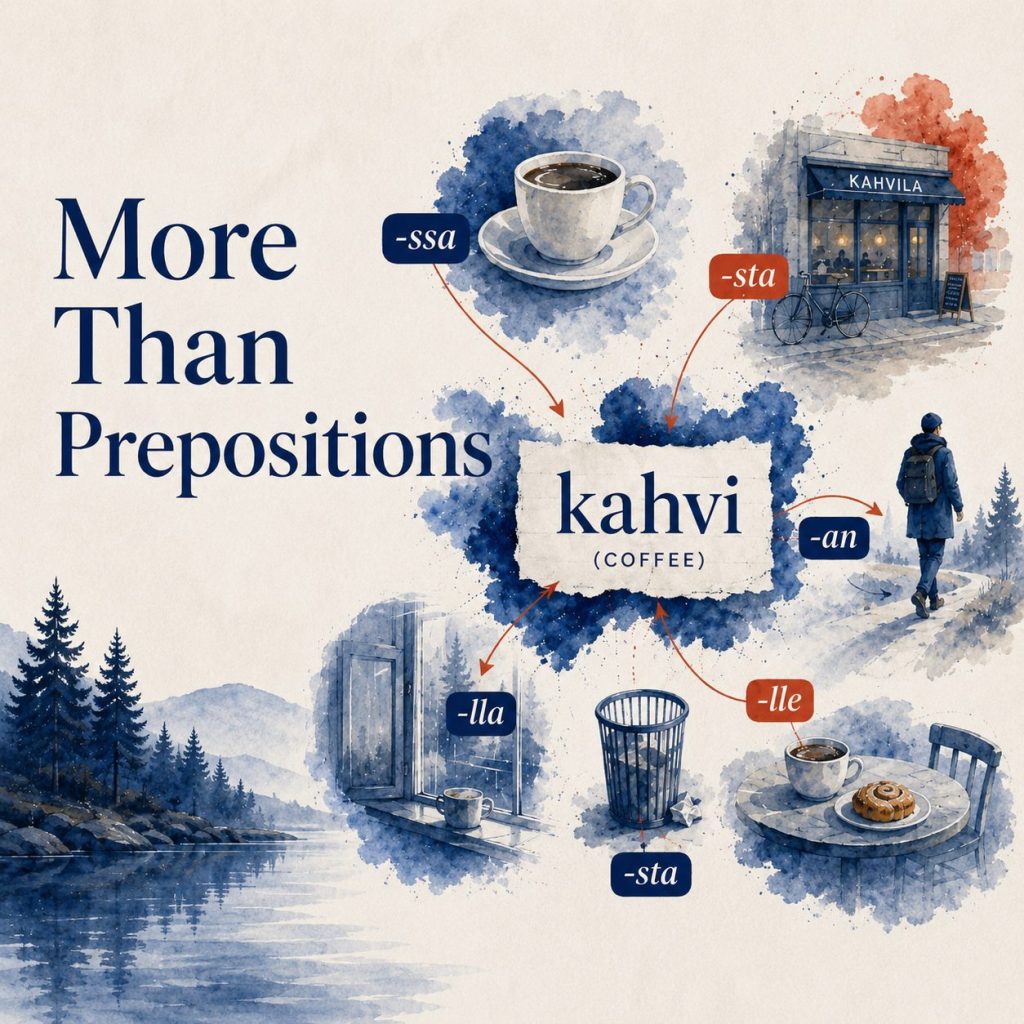
A common explanation is that Finnish cases replace English prepositions.
For example:
kaupassa = in the shop
kaupasta = from the shop
kauppaan = to the shop
That is useful at the beginning, but it is also too simple from a language point of view.
Finnish case endings do not only say “in”, “from” or “to”. They often describe the relationship between the person, the place, the action and the situation.
Compare:
Käyn kaupassa.
I’ll go to the shop (with the added nuance of coming back).
Menen kauppaan.
I’m going to the shop.
Tulen kaupasta.
I’m coming from the shop.
Olen kaupalla. (this example is perhaps not even that natural Finnish but used here to point out the possibilities of the language).
I’m at / around the shop area.
Kaupasta tuli viesti.
A message came from the shop.
The word shop is not just receiving a preposition. It is being placed inside a relationship: location, movement, source, direction, contact, role, situation.
This is why Finnish cases should not be taught only as “the Finnish version of prepositions”. They are part of how Finnish builds meaning.
* Albeit, I do this all the time, when learners are at the beginning of their journeys, it is fine, it is the right thing to do. Not ready to go deeper yet, not necessary.
2. Finnish object endings can describe completion, quantity and result
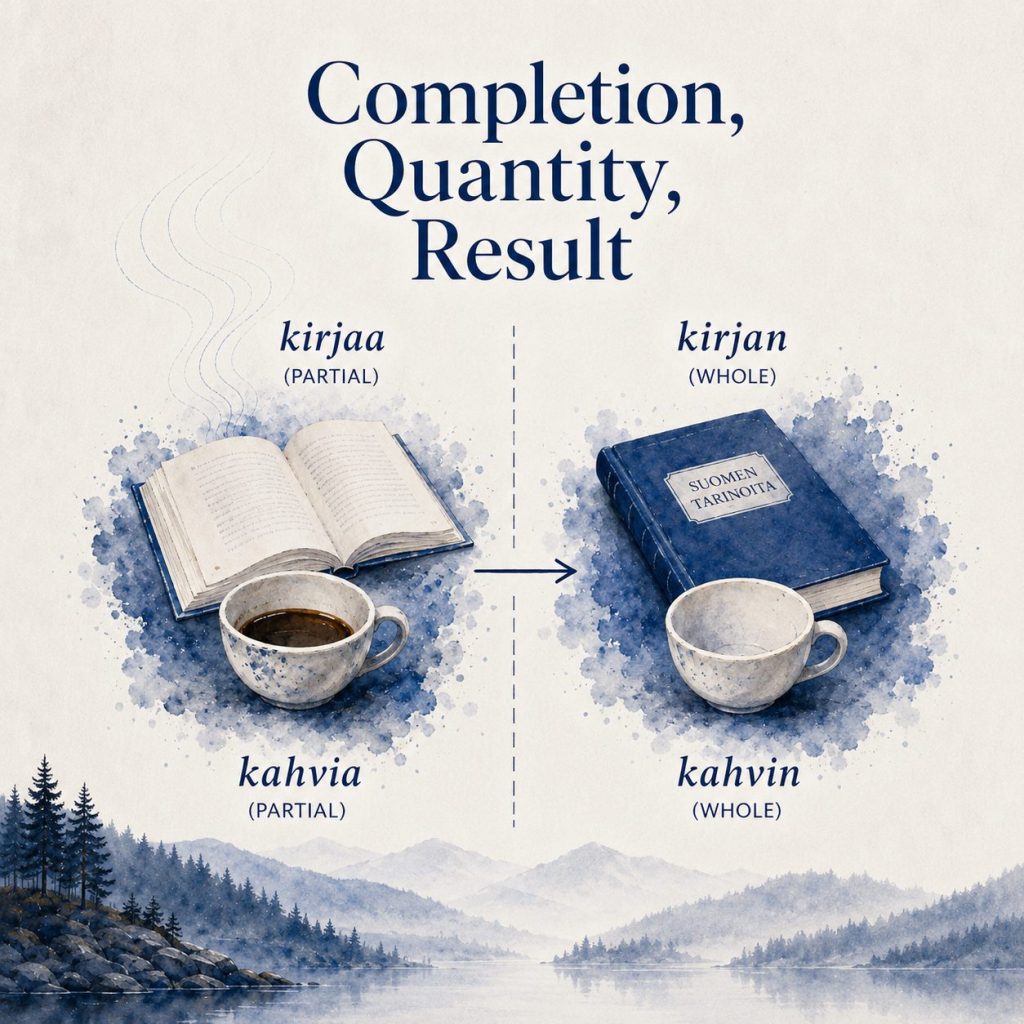
One of the clearest examples of Finnish precision is the object, and the well known partitive case (omg, feels like I am using swear words, my apologies).
English says:
I read the book.
But Finnish can separate meanings that English often leaves open:
Luin kirjaa.
I was reading the book / I read some of the book.
Luin kirjan.
I read the whole book / I finished the book.
That difference is not just “grammar”. It tells us whether the action is open, partial, ongoing or complete.
💡 Research note: [tap to see more]
VISK (Verkko-Iso Suomen Kielioppi) describes the partitive as commonly carrying the meaning of unboundedness: an indefinite quantity, a mass or set, or a situation presented without an endpoint. With objects, the partitive can relate to negation, quantitative indeterminacy, or unbounded aspect.
A simple example:
Join kahvia.
I drank coffee / some coffee.
Join kahvin.
I drank the coffee / one coffee / the whole serving.
English can express the same idea, but it often needs extra words. Finnish can place the contrast inside the object form.
This is one reason Finnish feels so precise. The ending is not decorative. It changes the mental picture.
3. Finnish can distinguish “something wrong” with very fine precision
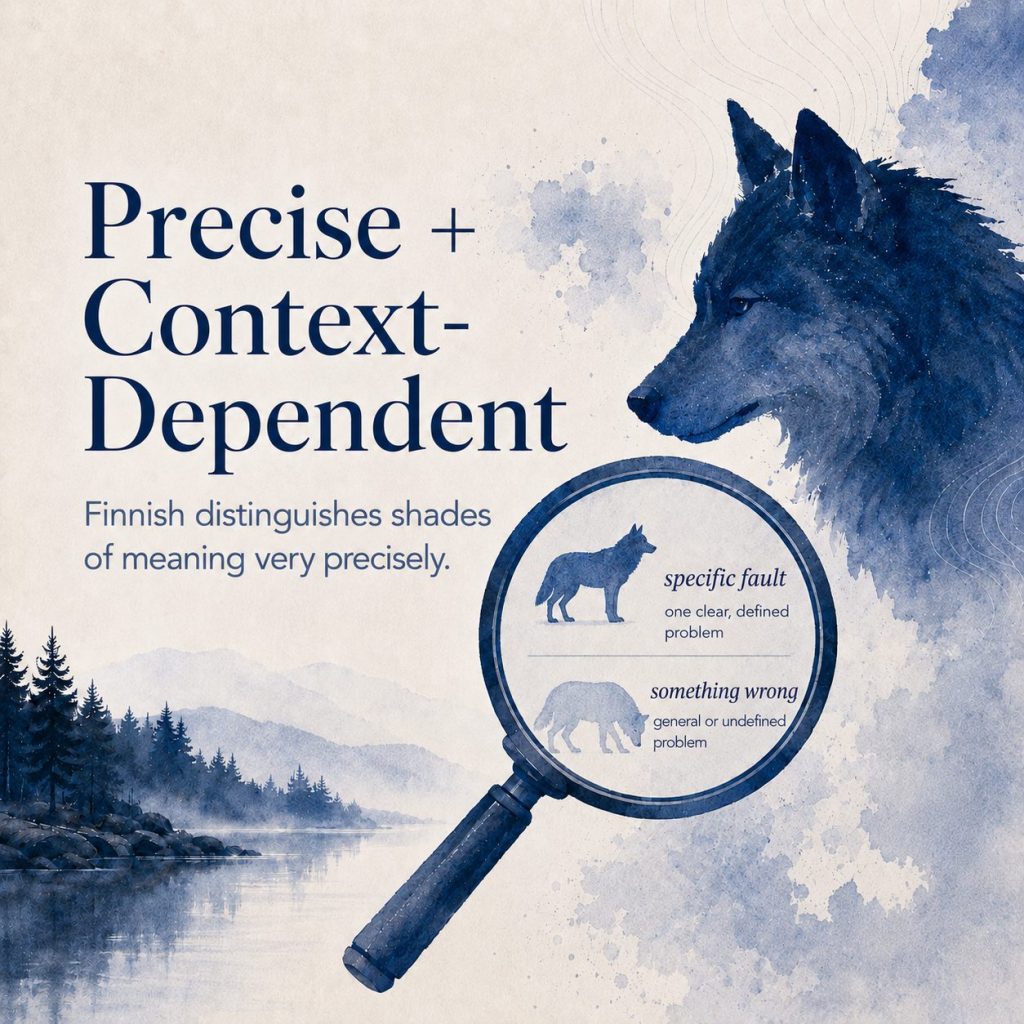
This is the kind of example that is difficult for learners but obvious to natives.
Sudessa on jokin vika.
There is a specific fault/problem in the wolf.
Sudessa on jotain vikaa.
There is something wrong with the wolf.
Sudessa oli vikaa.
There was something wrong with the wolf / the wolf was somehow faulty.
English gives us roughly “something wrong with the wolf”, but Finnish can adjust the level of specificity.
jokin vika points more towards a specific, identifiable problem.
jotain vikaa is more open: something is wrong, but we are not defining exactly what.
oli vikaa can describe the state more generally.
This is the part that can feel difficult and makes exact translations difficult if not nigh on (near) impossible: Finnish is not always trying to name the thing directly. Sometimes it is placing the thing in a very specific relationship of certainty, quantity, specificity and situation.
So Finnish can be precise not only about physical location, but also about how clearly something is known, or should be known already from the context, previous situation, relationship and so on.
4. Finnish verbs can carry person, mood, uncertainty and tone inside one word
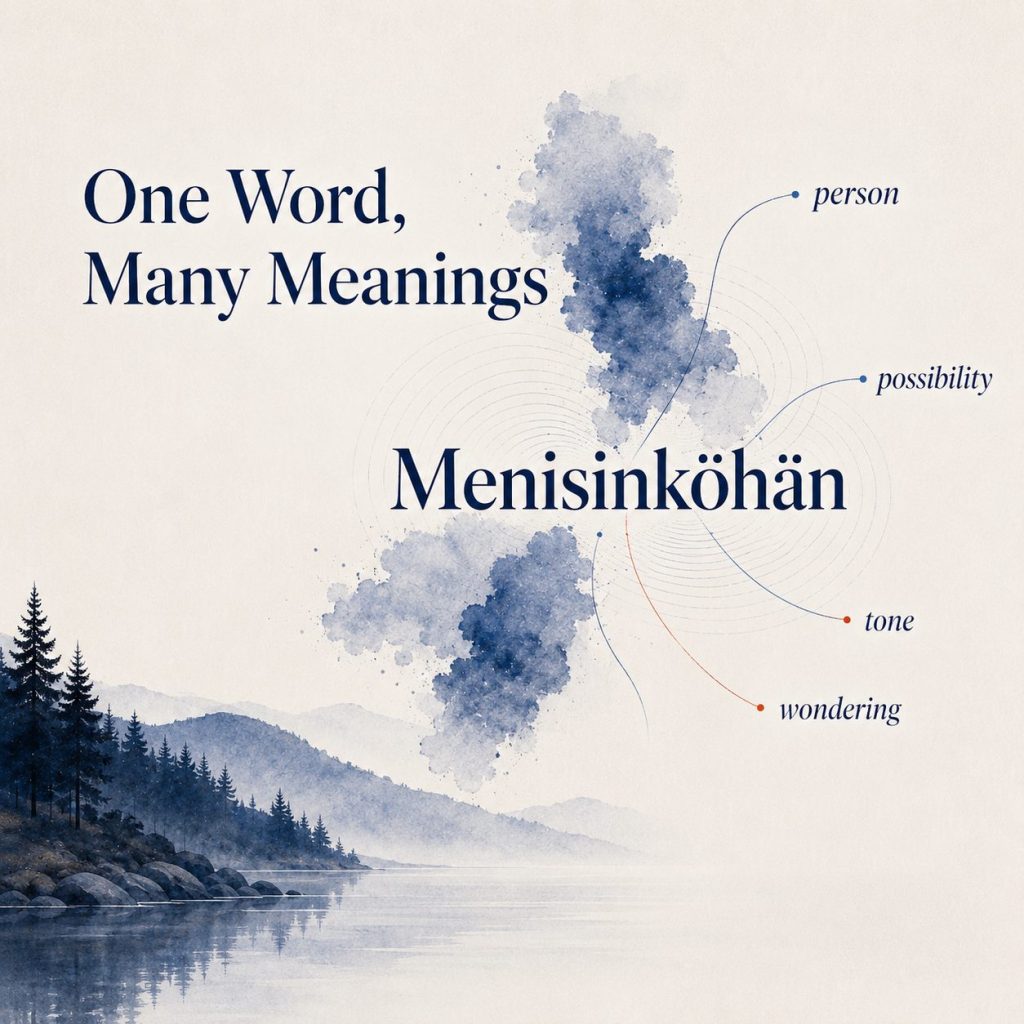
Finnish verb forms can contain information that English often needs several words to express.
Example:
Menen.
I go / I am going.
The subject “I” is already inside the verb ending -n.
Now compare:
Menisin.
I would go / I might go.
Menenkö?
Am I going? / Shall I go?
Menenköhän?
I wonder if I’ll go / I wonder if I should go.
Menisinköhän?
I wonder if I might go / I wonder if I should maybe go.
That last word is the perfect example of why Finnish can look terrifying from the outside.
Men-isi-n-kö-hän contains movement, conditionality, first person, question-like uncertainty and a soft thinking-aloud tone. Each ‘block’ or part of the word construction carries a meaning.
English needs a whole sentence with the tone also added by saying (almost in whisper to yourself):
I wonder if I should maybe go.
As a beginner, pre-intermediate, intermediate or even advanced learner, you do not need to worry about this. Any normal person would not expect you to be able to construct such things when speaking Finnish. Feel free to leave that to the weird native Finns who love to use their language in their own weird and wonderful way 🙂
What is important to learners is to appreciate that these possibilities and the whole Finnish system exist. You can begin to recognise and use basic words and common noun endings early on, and you will be able to communicate in everyday situations.
But there will be time when you hear a native person speak, and they will use a form that is unfamiliar to you and you might get lost in a conversation. It is not a time to panic! You just need to to remember that only the natives (as far as I know) are able to construct monstrosities such as ‘Menisinköhän?’ and even if you recognise a part of the word, feel free to clarify, “I heard about going somewhere, could you clarify what you meant?”, and we will be more than happy elaborate so that you can also ponder the same life questions with us – to go, or not to go?
💡 Research note: [tap to see more]
Kotus lists verb person endings and clitic particles such as tulethan, sinäkin, Timokaan and onpas as elements that can attach to Finnish word stems. VISK also describes -hAn as a particle that can soften an utterance, make it more suggestion-like, or appeal to shared knowledge depending on the context.
This is not “extra grammar for no reason”. It is compression.
Finnish can pack a whole attitude into one word. Isn’t it wonderful?
5. Finnish can be precise and context-dependent at the same time
This is THE paradox. This is where even a native speaker’s or teacher’s brain (including mine) can get a bit jumbled up. I have extreme and unconditional admiration for any professor, linguist or academic who have spent their lives and lifetimes deciphering the ins and outs of Finnish. Hat’s off to them 🎩
Let’s continue, Finnish can be extremely precise in the form, but at the same time the full meaning may depend heavily on context.
Example:
Mä käyn kaupassa ja tulen sitten.
This could mean:
I’ll go to the shop and come back.
But it could also mean:
I’ll go to the shop and then come there / join you / arrive afterwards.
The verb tulen does not automatically mean “come back to the exact place where I started”. It points towards the relevant place in the shared situation.
So the meaning comes from:
- the verb form
- the case form
- the previous conversation
- the shared plan
- the speaker’s and listener’s viewpoint
This is why “it depends on context” is true, but not enough as a teaching answer.
A better teaching explanation is:
Finnish often gives the grammatical shape, but the situation gives the final target.
6. Finnish often leaves the actor unnamed

This is another major difference from English.
Example:
Ei sitä noin tehdä.
(I can literally hear the tone and intonation that Finnish people use when they say this. It is a rather common expression).
A close structural translation is not really:
I wouldn’t do it like that.
It is closer to:
That is not done like that.
But even that is not perfect.
Finnish leaves the actor open. It does not choose between:
- I would not do it like that.
- You should not do it like that.
- We do not do it like that.
- People do not do it like that.
- That is not how it is done here.
The Finnish sentence can cover several of these meanings because the person is not the point. The action and the social frame are the point.
This connects with what linguists call zero-person constructions. Lea Laitinen’s work on Finnish zero person describes constructions where there is no overt subject, and the interpretation is built through interaction and human experience rather than a named person.
For teaching, I explain it like this:
Finnish often describes the situation before it names the person.
To know ‘the person’, you need to know the situation.
That is very different from English, where the sentence usually forces us to choose a subject early.
7. Why this makes Finnish feel difficult
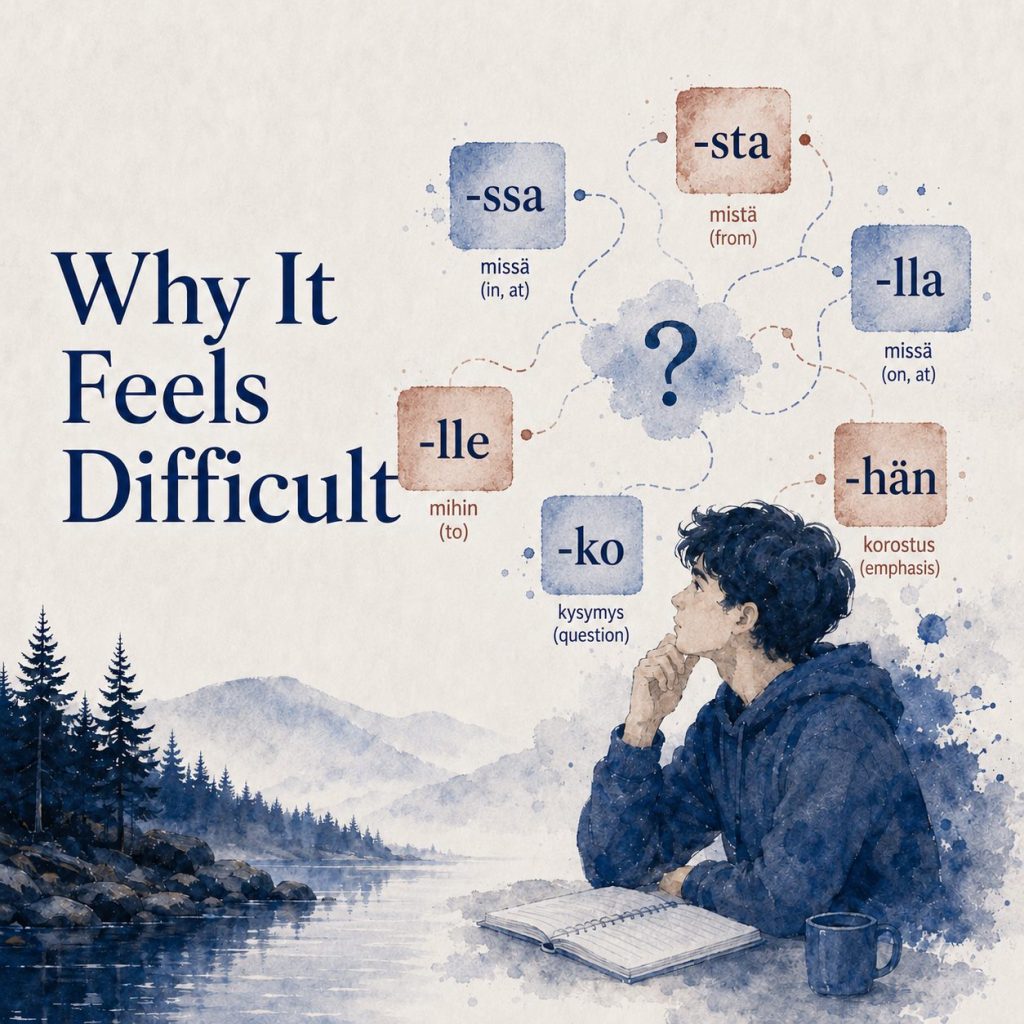
For many adult learners, this is hard because adult learners want to know why.
They do not only want to memorise:
kaupassa = in the shop
kaupasta = from the shop
kauppaan = to the shop
They want to understand why Finnish chooses one form and not another.
And the honest answer is:
Because Finnish is constantly asking: what is the relationship between the person, the thing, the action, the result, and the situation?
ALSO
Precisely because of this, we can understand you, even if you use the wrong ending or form.
Our brains are hardwired to read the situation long before your brain completed the translation and searched for the correct ending or form.
It is true that the meaning changes with the ending, but the situation did not and we know what you were trying to say, or what you meant to say.
Do not worry, it is inherent in the Finns to decode situations, not only the language.
If you take anything from this article, please take this comfort. And I hope I speak on behalf of most Finns when I say this is true: we can understand you, and no, we do not find it funny if you use the wrong ending.
We appreciate the intricacies of our language, and we are happy to support you or correct you, if you wish.
So moving on, this brings us to translations. It is often possible to translate word-for-word but it is highly unlikely to give you an accurate Finnish reply or sentence to a situation if the situation is abstract or unknown.
That sounds complicated, but it is also the key to making Finnish easier.
The problem is not that learners do not understand, or teachers struggle to give accurate answers. The problem is that Finnish cannot simply be viewed through an English-shaped system.
English often asks:
What word means this?
Finnish often asks:
What is the relationship here?
8. Why your Finnish teacher keeps asking “what happened before?”

This is something that happens again and again in teaching.
A student might ask:
What should I say if my boss says: “Can you explain this?”
And very often, the teacher cannot immediately answer.
Not because the teacher does not know Finnish.
Not because the teacher is trying to make things difficult.
Not because the student’s question is bad.
But because the Finnish answer may depend on the whole situation.
If the boss is simply asking for information, the reply might be neutral:
Joo, voin selittää.
Yes, I can explain.
If the boss sounds concerned, the answer may need to acknowledge the issue:
Joo, ymmärrän. Voin käydä tämän läpi tarkemmin.
Yes, I understand. I can go through this in more detail.
If the boss is questioning a decision, the reply may need to be more careful:
Voin avata vähän, miksi tähän päädyttiin.
I can explain a little why we ended up with this / why this decision was made.
If the situation is formal, the reply may need to be softer:
Totta kai, voin selventää asiaa.
Of course, I can clarify the matter.
So before giving “the Finnish answer”, a teacher may need to ask:
Why did your boss say that?
What happened before?
Who was there?
Was it a problem, a suggestion, a complaint or just a normal comment?
Was the tone friendly, annoyed, formal, casual or urgent?
Had you already agreed something earlier?
Are you replying as an employee, a colleague, a customer, a manager or a friend?
Sometimes the student then says:
No, no, it didn’t actually happen. I’m just asking: if my boss says this, what do I say?
And this is exactly where the difference between Finnish and English becomes visible.
In English, it may feel natural to take one sentence and ask for “the Finnish version”. But Finnish does not always work like that. A sentence is not always enough. The situation may decide the correct Finnish.
The English sentence may look the same, but the Finnish answer depends on the relationship, the previous situation and the purpose of the reply – Finnish is (or can be) precise.
So when a Finnish teacher asks many questions, it is not avoiding the answer.
They are trying to find the correct Finnish answer.
This is one of the hardest things to explain to learners:
You cannot always translate an English sentence into Finnish and expect it to fit a different situation.
However, as a learner, you do not need to worry about this too much. You can communicate very effectively with simple, practical Finnish.
Even at quite high levels, people can function well without understanding every layer of this system.
9. The important message: Finnish can be learned

Finnish is not impossible.
Finnish is friendly.
Finnish is learnable because it is not random.
The endings are not chaos. They are signals.
In the beginning, as a learner you do not need to master the whole system. You need enough Finnish to function.
Most, if not all, people learning Finnish do not aim to become native-level speakers. They need to survive daily life, speak to people, understand common situations, and slowly build confidence.
There is also a realistic point here: reaching fully native-like ability as an adult is not the usual outcome in second-language learning. Large-scale research on second-language acquisition suggests that age of first exposure strongly affects the likelihood of native-like ultimate attainment, although adults can still reach high and very useful levels of proficiency.
So the goal does not need to be, and usually isn’t, “become a native Finn”.
The usual goal is:
Understand enough. Speak enough. Participate enough. Keep going.
Finnish is different from many languages but the basics of learning it are the same as many others too. You can learn 15-25 verbs, pronouns of course, basic everyday nouns and how to say where from, at in and so on.
And you are good to go take the bus, go to a cafe, go shopping etc.
And honestly, that is already a lot. It is enough to start living life in Finnish, not just studying Finnish.
10. My teaching approach

I do not teach Finnish as:
Here are 15 cases. Memorise them.
And I do not teach it as:
It depends on context. Good luck.
I frame it more like this:
Let’s learn it bit by bit.
Let’s see where the patterns occur.
Let’s learn one situation at a time.
Let’s learn the basics first, and then slowly build the bigger picture.
My own conclusion, after teaching Finnish (and thinking about languages far too much), is that you, the learners, do not need to attack the whole Finnish case system at once, nor do you need to feel being attacked by it.
Yes, Finnish has 15 cases. Yes, they exist. Yes, you will probably see a big scary table somewhere and wonder what life choices led you to that moment.
But for everyday communication, there are a smaller number of central forms that matter first.
In practical terms, I usually start with around six central case functions. But I do not teach them as one perfect table with one perfect noun, because real language is not a perfect table.
The forms need to be connected to real-life situations from the beginning:
- the basic form: kahvi — Tämä on kahvi. / This is a coffee.
- the partitive: kahvia — Juon kahvia. / I drink coffee / some coffee.
- the genitive/ownership form: Marian — Tämä kahvi on Marian. / This coffee is Maria’s.
- the “in” form: kaupassa — Maria käy kaupassa. / Maria goes to the shop / pops into the shop.
- the “from” form: kaupasta — Maria tulee kaupasta. / Maria comes from the shop.
- the “to” form: kauppaan — Maria menee kauppaan. / Maria goes to the shop.
*I don’t even like shopping, it’s all lies.
Everything should be based on real-life situations. And if you have read this far, you already know me a little bit, so this is also a real-life situation for you 🙂
Of course, other cases appear very quickly too, especially forms like Marialla, Marialta, Marialle. But the point is not to pretend the rest of Finnish does not exist.
The point is to give you a realistic starting map.
Once these core relationships begin to make sense, you will already be able to communicate many normal things in everyday life:
going to a café, ordering food, asking where something is, talking about where you are going, where you came from, what you did, what you bought, what you need, and what happened.
That is central to how I teach Finnish.
Let’s not try to eat the whole elephant in one go. Let’s take it bite by bite, bit by bit. With each small piece, the picture becomes clearer and the elephant gets smaller and smaller.
(Not that I suggest that anybody should eat elephants. It is a metaphor. Please leave the elephants alone.)
Finnish can be made very logical from the beginning when it is taught in the right order and through real situations.
You need to be taken on a journey of understanding, not hit over the head with monstrous grammar and expected to remember everything by force.*
* Albeit, may the force be with you.
Because memory is unreliable.
Human memory is often the first thing that fails when learning a language. If a learner is only told:
This ending means this.
This ending means that.
This ending means this other thing.
then the brain has to store a long list of disconnected information. And disconnected information is easy to lose (like your phone, keys, things like that, same category really).
That is why I prefer to guide you, the learner, through the logic of the form:
Why is this ending here?
What relationship does it show?
What is happening in the situation?
What does this form help the listener understand?
When the learner engages their own brain and goes through the process of understanding, the information has a much better chance of staying there.
This is not about making grammar heavier. It is the opposite.
It is about making grammar meaningful.
A Finnish ending is not just an ending. It is often a small instruction telling the listener how to understand the situation.
So instead of asking only:
What does this word mean?
you can slowly learn to ask:
What is this form doing?
That question changes everything.
Working conclusion
Finnish is not difficult because it is illogical.
Finnish appears difficult because it is logical in a different way.
It can be extremely precise, but the precision is often stored in places English speakers are not used to looking: endings, verb forms, object cases, missing subjects, small particles and shared context.
But you do not need to worry about every nuance from the beginning.
You do not need to understand every possible shade of Finnish before you start speaking.. You do not need to sound native to communicate.
The aim is not to decode every possible meaning like a native speaker from day one.
The aim is to introduce the patterns gradually, one useful situation at a time.
Finnish is not random.
It is structured.
It is precise.
And yes, it can be learned.
It can even be fun, when it is taught as a system of meaning instead of a monster list of endings.
Give it a try and join one of my courses 🙂
One tiny final note
If you have read this far, huge congratulations.
Even if you only skim-read, I appreciate it very much.
I would love to hear something in the comments, even if it is just:
I read it.
I got to the end.
Still here.
It helps me know that writing these articles is worth it, and it also helps keep me going.
Thank you again for reading, and if you are a learner of Finnish, hope to see you in class.



Leave a Reply