
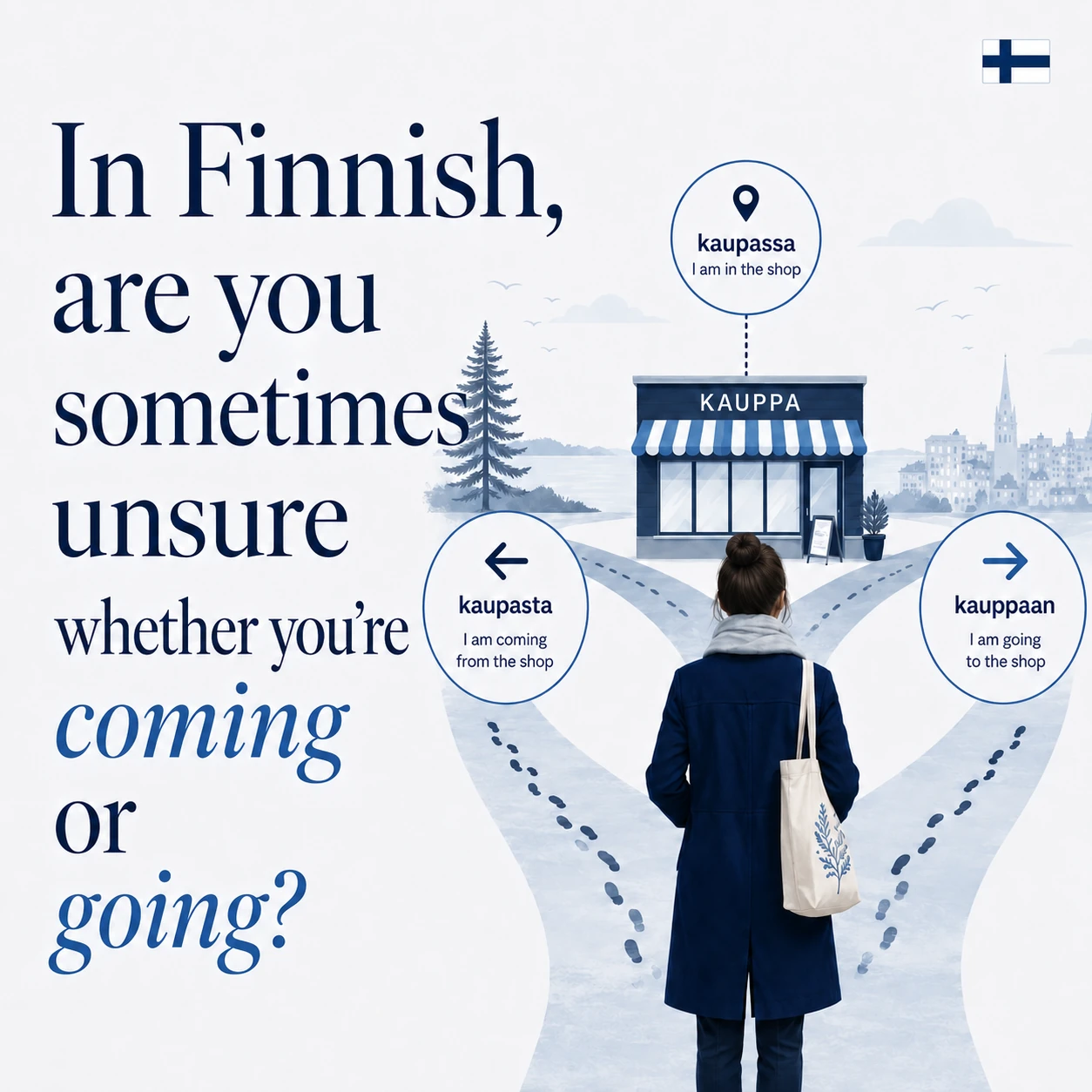
Finnish can make a very normal trip to the shop feel like a small navigation exercise. Are you in the shop, coming from the shop, going to the shop, or just popping out/in* and coming back?
* see what I did there, ‘popping out’ to the shops, ‘popping round’ to my mates…
If you are an early learner of Finnish, I promise this is worth reading and absorbing. Fairly sure most will scan read the first time but once you have 10-15 minutes to spare, I would suggest coming back to it later and really learning and noticing the pattern.
I promise that the rest of your Finnish journey will be smoother.
The good news is that this is not random. Finnish is showing you place, movement and direction. Once you understand the pattern with one familiar word, you will start seeing the same logic everywhere.
Here, you are not just learning one grammar point.
You are training your pattern recognition, and that is what makes Finnish feel much less chaotic.
1. Three place forms
Let’s explore one familiar word first: kauppa.
kauppa changes depending on the place idea:
📍 kaupa-ssa = in / at the shop
⬅️ kaupa-sta = from the shop
➡️ kauppa-an = to the shop
(elongated vowel and -n)
| Question | Meaning | Finnish form | Example |
|---|---|---|---|
| 📍 Missä? | where? / in or at | kaupa-ssa | Olen kaupassa. |
| ⬅️ Mistä? | from where? | kaupa-sta | Tulen kaupasta. |
| ➡️ Mihin? | to where? | kauppa-an | Menen kauppaan. |
2. Five important verbs & related questions
Let’s learn the verbs together with the question form and the place form.
| Verb | Meaning and logic | Question | Place form | Example |
|---|---|---|---|---|
| 📍 olla | You are in or at a place. | missä? | kaupa-ssa | Olen kaupassa. |
| 🔄 käydä | You visit a place and come back. | missä? | kaupa-ssa | Käyn kaupassa. |
| ⬅️ lähteä | You leave from a place. | mistä? | kaupa-sta | Lähden kaupasta. |
| ⬅️ tulla | You come from a place. | mistä? | kaupa-sta | Tulen kaupasta. |
| ➡️ mennä | You go to a place. | mihin? | kauppa-an | Menen kauppaan. |
In these examples, the verbs and place forms work together like this:
📍 olla + käydä → missä? → kaupassa
⬅️ lähteä + tulla → mistä? → kaupasta
➡️ mennä → mihin? → kauppaan
Important: tulla and lähteä can also be used with mihin? when we are talking about the destination:
Tulen kauppaan.
Lähden kauppaan.
3. Home and Work Have Special Place Forms
Home and work have special places in our hearts, and also in the Finnish language.
These are not random places in daily life. We talk about them constantly, we move between them constantly, and Finnish gives them very common everyday forms. They deserve a little special treatment.
Home: koti
Koti is not treated exactly like kauppa. Home is such a central word that it has its own very common forms. It is not just another place on the map, it is the place where you go back, leave from, stay in, and probably forget your keys.
Learn these first as fixed chunks:
kotona = at home
kotoa = from home
kotiin = home / to home
Examples:
Olen kotona.
I am at home.Lähden kotoa.
I leave home.Menen kotiin.
I go home.Tulen kotiin.
I come home.Käyn kotona.
I go home and come back.
Work: työ
Työ is also special in everyday Finnish. Work is not only a physical place, it is also a routine, a responsibility, and for many people, a major part of daily life. Finnish reflects that by using very common practical forms for “at work”, “from work” and “to work”.
Learn these first as fixed chunks:
töissä = at work
töistä = from work
töihin = to work
Examples:
Olen töissä.
I am at work.Lähden töistä.
I leave work.Menen töihin.
I go to work.Tulen töistä.
I come from work.Käyn töissä.
I go to work and come back.
So yes, probably the two places where you spend the most time, home and work, have special forms in Finnish.
Don’t worry.
Take your time with these.
Once you master this logic, everything else will flow from there.
You are not just learning three endings, you are building the pattern recognition that makes the road a lot smoother.
Learn Finnish through real situations, not random grammar
This is the kind of pattern we practise in my Finnish classes.
We do not study grammar as a long list of rules to memorise. We start with real-life situations, such as going to work, coming home, visiting the shop, speaking with a colleague or managing everyday life in Finland. Then we slow down, notice the pattern, and practise it in small, useful chunks.
That is how Finnish starts to become more natural. You learn what to say, when to say it, and why the sentence works.
My teaching focuses on:
real-life Finnish you can actually use
speaking practice from the beginning
bite-sized grammar inside practical situations
pattern recognition so Finnish feels less random
ready-made sentence models that help you speak with more confidence
The goal is not to understand one grammar table perfectly. The goal is to build the kind of Finnish you can use in everyday conversations, step by step.
The latest course intake is now open for small-group Finnish courses.
Come and learn Finnish in a clear, practical and human way.



Leave a Reply