
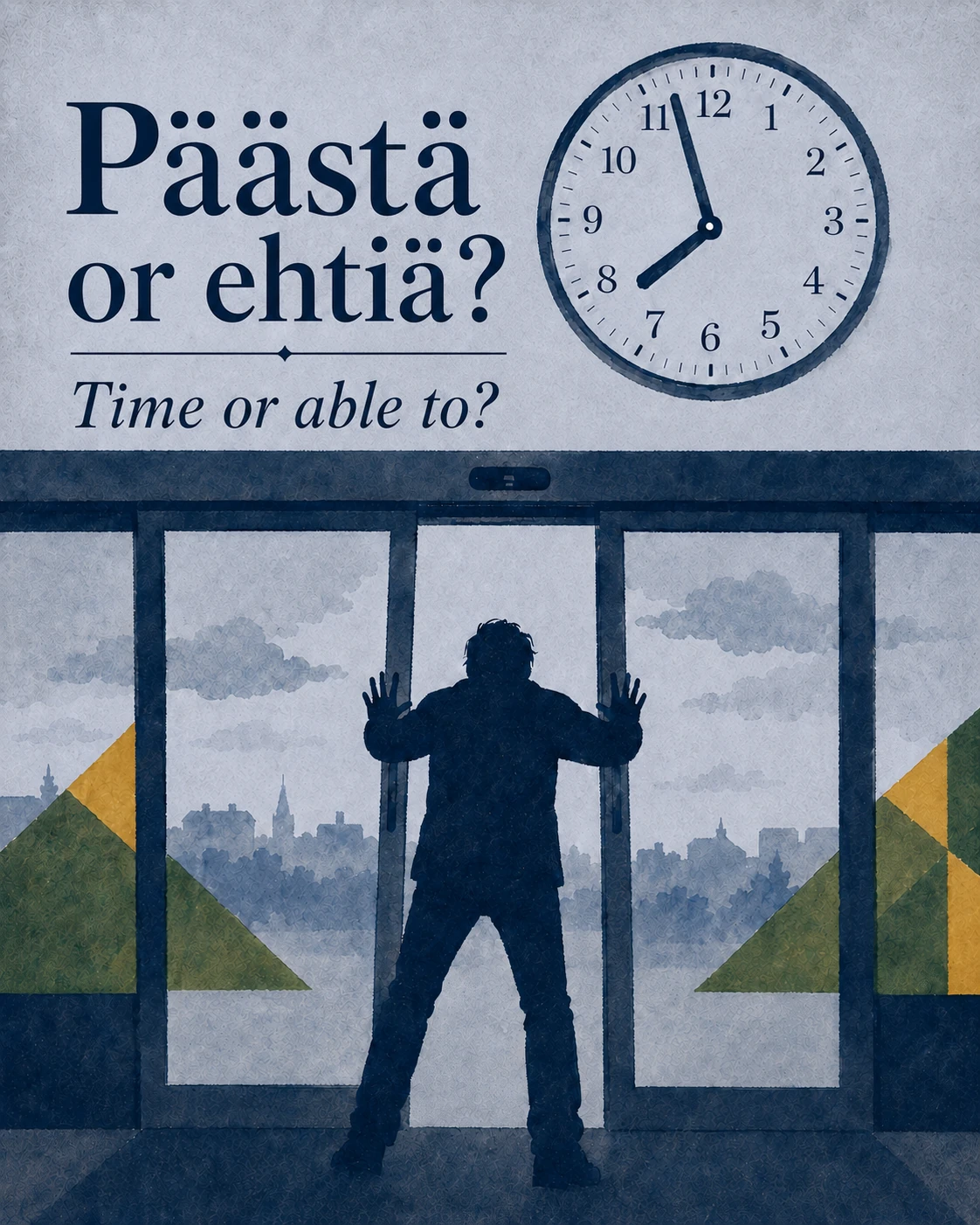
“Can you come at six?”
A perfectly normal question in English.
Unfortunately, can is doing suspiciously little work here.
Are you asking me whether:
I have enough time?
Whether I am free?
Whether my boss will let me leave?
Whether there is a bus?
or
Whether I have somehow become trapped inside Prisma?
Finnish is being slightly nosy here. It wants to know what kind of a problem you have.
This article was inspired by a question from a student when ehtiä and päästä appeared next to each other during a lesson.
The learner’s question was completely reasonable:
What is actually the difference?
The funny thing about teaching your own language is that you can use two words correctly for decades, well, your whole life really, without thinking about them. Then a learner sees them side by side, looks at you questionably and waits. You feel under pressure.
Back to the article…suddenly, you have to investigate your Finnish brain.
Think of it like this:
👀 Ehtiä looks at the clock. ⏰
👀 Päästä looks at the obstacle. 🚧
That is the main difference.
Ehtiä: Is there enough time?
Use ehtiä when the question is about time.
Do I have enough time? Will I arrive before a particular time? Can I fit something into my schedule?
Mä ehdin kuudeksi.
I make it for six o’clock.
Mä en ehdi puoli kuudeksi.
I do not make it for half past five.
Ehditkö tulla töiden jälkeen?
Do you have enough time to come after work?
Perhaps you are working until five, meeting your friend at six and you still need to:
collect a child,
buy milk (from Prisma perhaps)
and
cross Helsinki during rush hour.
This is an ehtiä problem.
The enemy is the clock.
Päästä: Is it possible?
Use päästä when something affects whether you are able or free to come, join or participate.
Mä pääsen mukaan.
I am able to come along.
En pääse perjantaina.
I am not able to come on Friday.
Why not?
We do not know.
Perhaps you are working.
Perhaps you have another appointment.
Perhaps nobody can look after the children.
or
Perhaps you simply cannot escape from Prisma.*
* Does this make Prisma the enemy or is that just too far fetched? Reply in the comments.
The important point is that something is preventing you.
A little bit more to go…
Päästä has a couple more jobs to do
The somewhat sad reality is that päästä is not a one-trick-pony. It has a few more meanings but we will stick to the topic of ‘time’ and ‘to be able to do something’ for now.
When work finally sets you free
Mihin aikaan sä pääset töistä?
At what time do you get free from work?
You are not asking whether the person has enough time to leave work.
You are asking when work releases them back into the wild.
When päästä becomes a time machine
Päästä also appears when something happens after a certain amount of time:
Viiden minuutin päästä.
After five minutes.
Nähdään tunnin päästä.
We see each other after one hour.
So päästä can get you out of work and drop you in to the future depending on the context.
Not bad going for one little verb.
A very special mention to my beloved student Juls, who continues to inspire me to make Finnish more accessible and less scary, one mystery and one real-life situation at a time.
Other articles related to Prisma
Are You Just Trying to Survive Prisma?
Are you a learner still reading this? Would you be interested in my new Surviving Prisma course that is coming soon? Comment below.

Leave a Reply